by Ryan J. Witkos
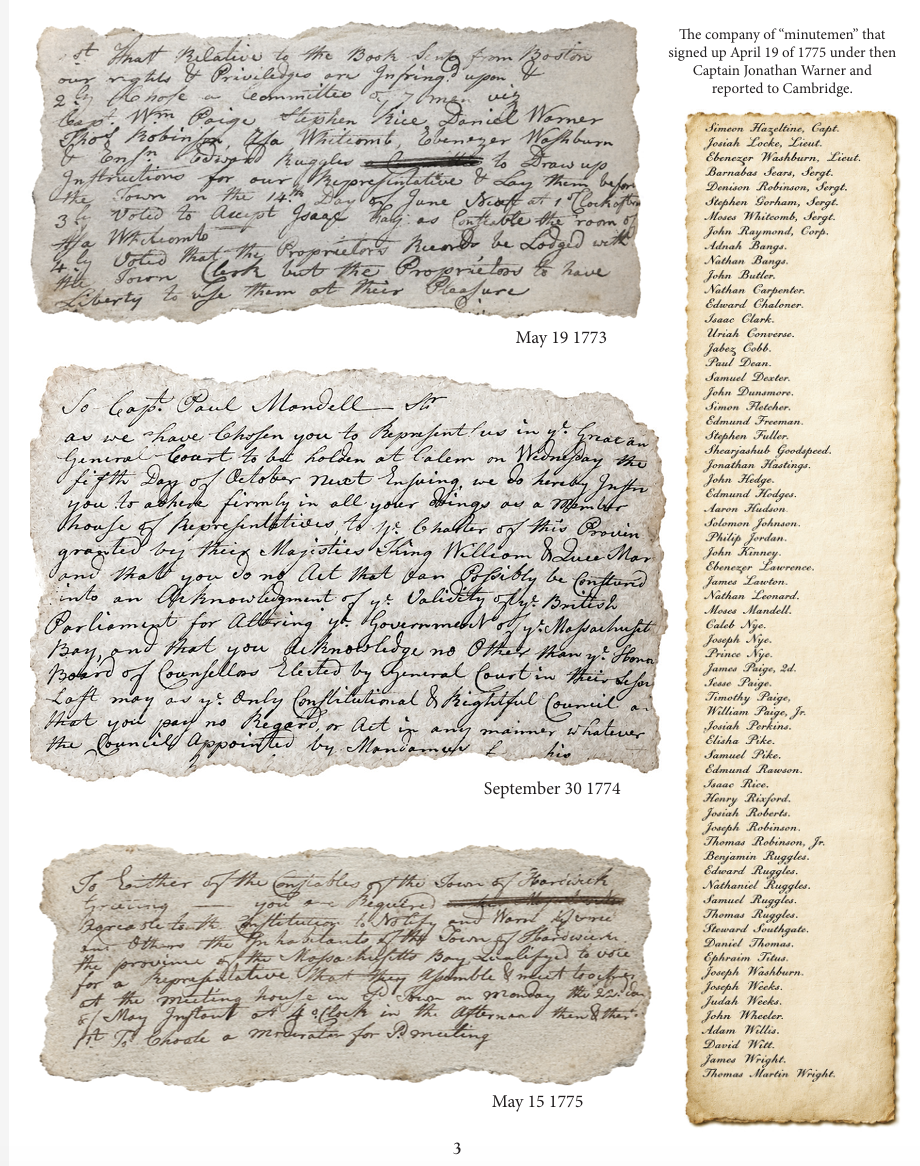
On May 19, 1773, the Town of Hardwick received from the Town of Boston a book now commonly referred to as the “Boston Pamphlet” which listed three categories of rights the colonists were entitled to: The Natural Rights of the colonists as Men; The Rights of the Colonists as Christians; The Rights of the Colonists as Subjects [of England]. In addition, the Boston Pamphlet listed twelve enumerations “of some of the most open Infringements of our Rights... in order to obtain a Redress of the Grievances.” Hardwick voted on May 26, 1773 that, “...Relative to the Book Sent from Boston that our rights & Priviledges are Infringed upon.” The Town further voted a committee to draw up instructions, which were accepted on June 14, 1773 and given to Capt. Paul Mandell as the Town’s representative.
The instructions to Capt. Mandell included the following: “...you will exert yourself in every Proper, & Constitutional way for the securing & maintaining our rights and Priviledges, & for the supporting our Ancient happy form of Government...; ...that you will never give up that right into the power of others, which the Law of God, Nature & Nations hath invested us with –; & restore that mutual harmony & Confidence between the British Nation & the American Colonies, which we look upon to be of the almost Importance & Necessity, to secure the Emolument & welfare of both, and in this way hope under the smiles of Heaven our Natural Rights as Christians & Subjects will be fixed on such a Sure Basis, as that all future Attempts to Invade or destroy them will prove Entirely fruitless & Abortive”.
The Town was clear in its instructions. They wanted King George III to know they were “...at all times proving ourselves Loyal & Dutifull Subjects, so we particularly Recommend this to your serious consideration hoping you will always be ready to join with others in this and all other measures that shall be likely to relieve us in the most Easy & happy manner and most Effectually Secure our Invaluable right & Priviledges.”
Britain had infringed and violated the rights of the colonists. The town’s inhabitants wanted to demonstrate to the Crown that while they still wanted to be subjects, they would not tolerate what Britain was doing.
After the September 6, 1774 revolt at the Worcester courthouse, the Town voted on September 30, 1774 in its instructions to Capt. Mandell that “we do hereby instruct you to adhere firmly in all your doings as a Member of ye House of Representatives to ye Charter of this Province granted by their Majesties King William & Queen Mary and that you do no Act that can possibly be confused into an Acknowledgement of ye Validity of ye British Parliament for Altering ye Government of ye Massachusetts Bay... to act upon such matters as shall then come before you, in such a manner as may appear most conducive to the true Interests of this Town & Province most likely to Preserve the Liberties of North America.” Here, the Town once again expressed its disapproval of what Britain was doing to the form of government in Massachusetts.
After the events at Lexington & Concord of April 19, 1775, the Hardwick Selectmen on May 15, 1775 placed an article for a Town Meeting “to Elect one or more persons to Serve for & Represent them in a Provincial Congress to be held at the meeting house in Watertown on Wednesday the thirty first Day of May Instant... and to consult Deliberate & resolve upon such further measures as under God shall be effectual to Save this people from inestimable Liberties derived to us from our Ancestors and which is our Duty to preserve for posterity”.
What makes this action stand out is that the record shows a strikethrough in the instructions to the Constable for the Town Meeting warrant. Typically, all Town Meeting warrants typically begin with “To Either of the Constables of the Town of Hardwick, Greeting” and will then identify the authority under which the Town Meeting is being called. For the May 22, 1775 Town Meeting called on the 15th, the record initially shows the authority is from, “in His Majesty’s name.” That those four words have been stricken demonstrates Hardwick no longer wished to be subjects of the Crown.
No subsequent Town Meeting warrant mentions the Crown and instead uses warnings in 1775 such as: “Greeting you are hereby required to notify & warn the Freeholders and others the Inhabitants of the Town of Hardwick Qualify by the Law of this Colony to vote;” 1776: “Greeting – you are required agreable to the Government & People of this State to Warn all the male persons of 21 years of age & upwards that are free that they assemble & meet together at the meeting house;” 1777: “You are required in the Name of the Government & People of this State of the Massachusetts Bay to notify & warn the Freeholders & others the Inhabitants of sd Town of Hardwick that they assemble & meet together.”
